

Changing up my NFL Draft evaluation grading scale
Change is a good thing!

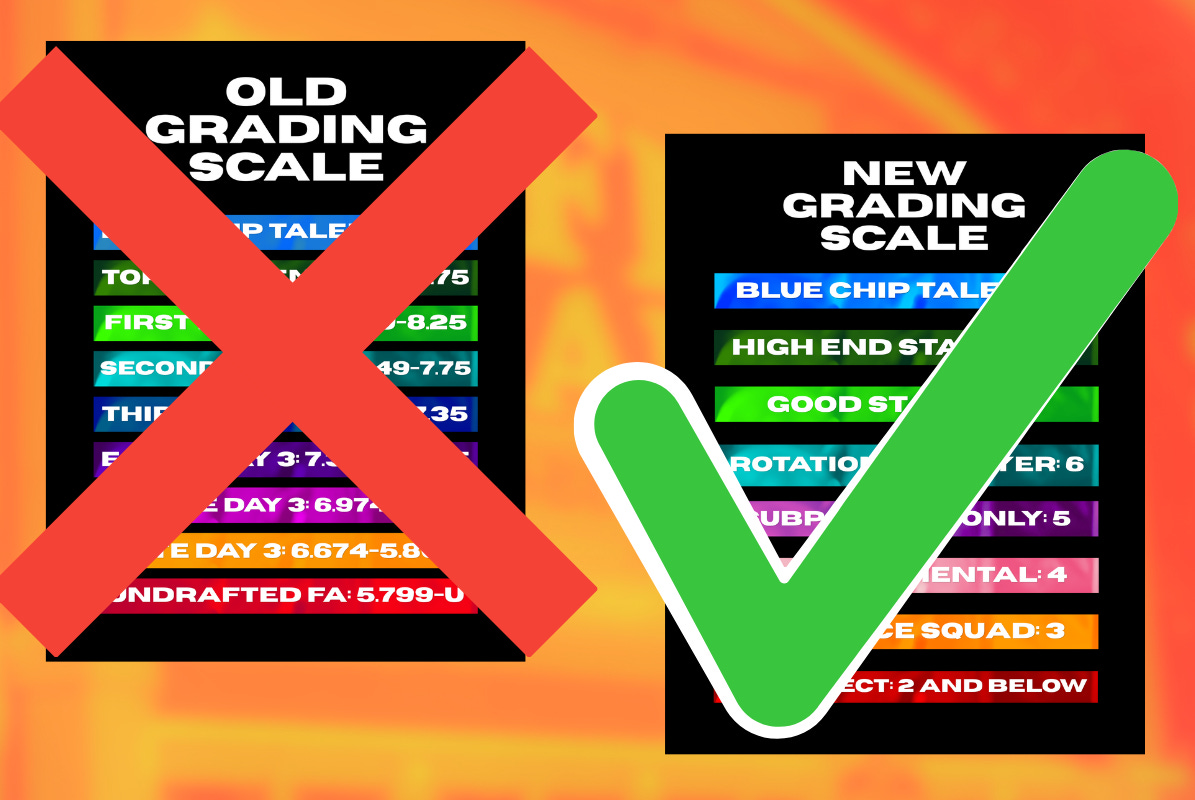
The sun has set on one NFL Draft class, and it is rising on another as we look forward to the 2027 NFL Draft class.
And before summer scouting starts, this is a good period to reflect on my process, how it matches how NFL teams are seeing players, traits, and more. That process has begun for me, and it starts with my grading scale on how I am evaluating players as they head to the NFL level.
Here, we take a look at my old grading scale and why I am looking to make the change. We’ll then take a look at the new grading scale, define each of the tiers, and explain why this will be a welcome change moving forward.
NFL Draft Grades and Tiers: What kind of long-term foundation did teams build?

NFL Draft grades are all the rage right now. Or reason for rage. The consensus board is bad! The consensus board is good!
Looking at the NFL Draft grading scale evolution
So, here is the old grading scale:
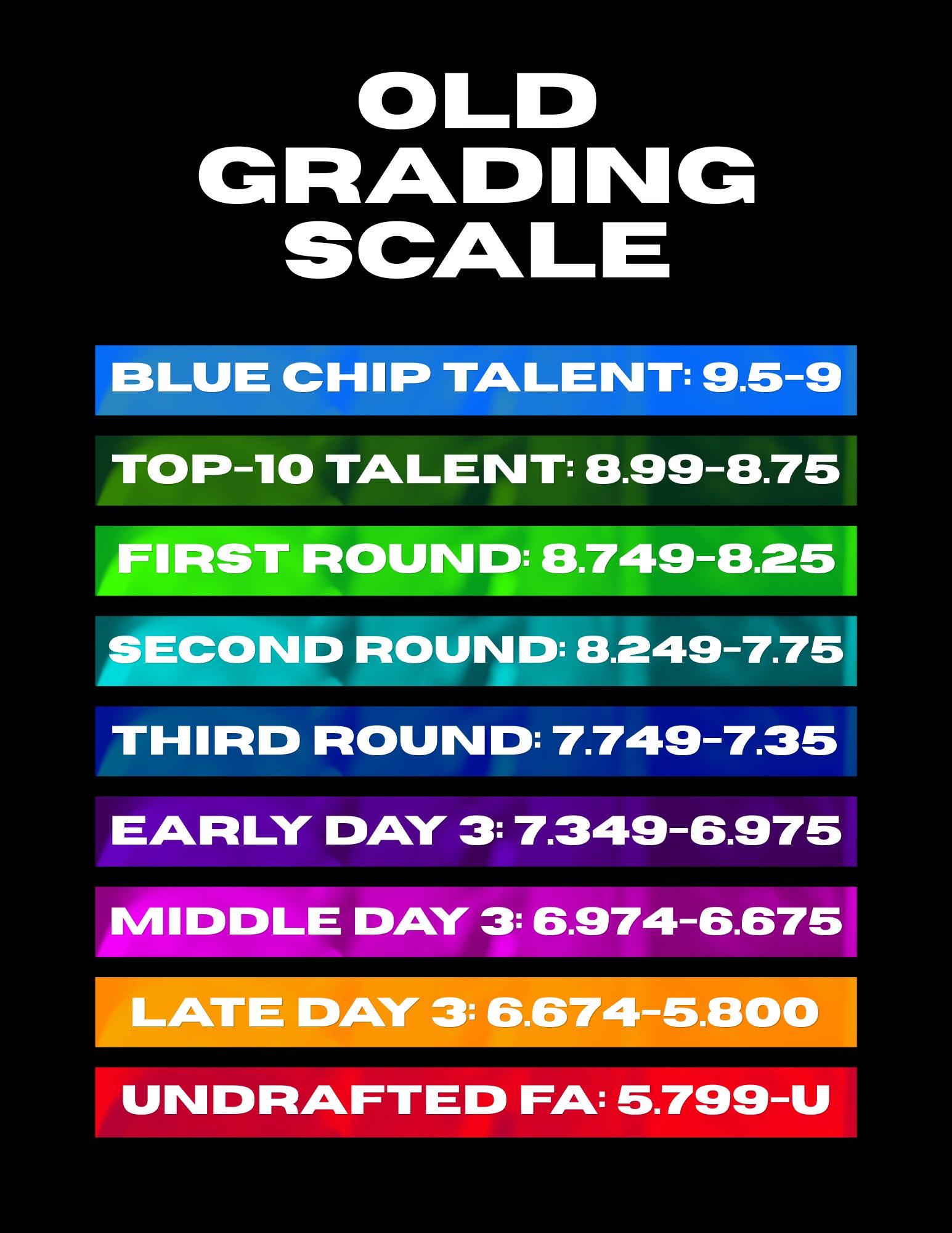
This got way too into the weeds. Just look at it! It’s a mess. Going back three decimal points is messy and harder to digest as well. I also do not love grading players out by a “per round” basis; I want to move to a “by role” basis.
This helps, especially from a content creation perspective, to communicate exactly what track a player is on when drafted, or more specifically, what role I see for that player at the NFL level. What good does it do to tell readers that I think, for example, that wide receiver Josh Cameron is a mid-Day 3 player? What does that mean for his future at the NFL level?
So, here is what the new scale looks like:
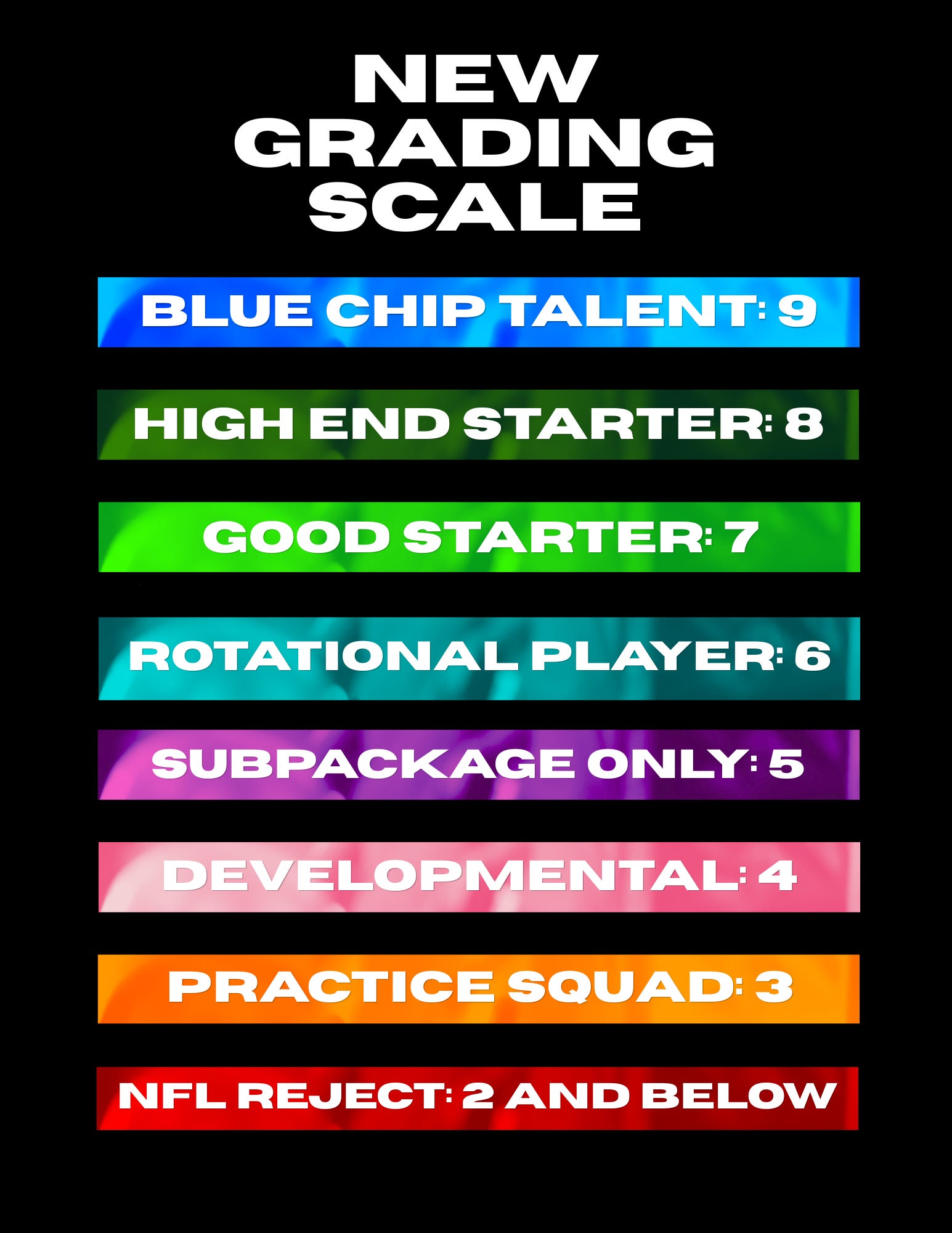
Now, by changing the verbiage (and number scaling to a cleaner look), you can see that I think a player, despite being drafted in the first round, is only a rotational player. Or, you can see that, despite being selected in the sixth round, I think that player could be a subpackage player, even early in their career!
Defining these new grading tiers
This new scale helps to define who I think a player is at the NFL level, and not what nebulous round I think the player will be drafted in. Let’s talk about what these tiers mean.
Blue Chip Talent: The cream of the crop still deserves to be separated into its own tier. This is a player who not only makes an immediate impact for a team but has true All-Pro potential at the NFL level. The easiest example of a blue-chip talent would be Cleveland Browns defensive end Myles Garrett.
High-End Starter: A player who will be drafted to fill a role at the top of the depth chart. Not only is that player expected to start, but is expected to see enough output to have Pro Bowl potential. Buffalo Bills offensive tackle Dion Dawkins fits this tier.
Good Starter: Teams don’t have rosters of 22 Pro Bowlers. It’s impossible. Teams need players whom they can put into their starting lineup who will simply not be liabilities. The unsung heroes of a team that hold a roster together. Think D.J. Reader on the Cincinnati Bengals a few years ago, or even Kenneth Walker on the Seattle Seahawks this past season.
Rotational Player: This is a player who can not only play in every-down situations on a rotational basis, but could start in a pinch without any sort of liability to their game. Missouri EDGE Zion Young from this past class is a player who comes to mind who fits the bill. Baltimore Ravens running back Justice Hill is another. You can have a long career being a rotational player!
Subpackage Only: Third down backs like Samaje Perine or Dare Ogunbowale stand out here. Players at other positions include DIME cornerbacks, DIME linebackers, or smaller pass rushers like James Houston or Josh Uche.
Developmental Player: Traits are worth shooting on, but perhaps not as a Day 1 starter. This is a draft and stash sort of situation. Dallas Cowboys quarterback Joe Milton is a prime example of this, as is now-retired offensive tackle Yosh Nijman. Take the shot on tools, but patience will be required.
Practice Squad: Pretty self-explanatory here. A player you can stash on your practice squad developmentally, but a player you’re not super worried about getting poached away by another team. This player can be called up to the active roster every once in a while to contribute on special teams or in an emergency, but can be churned off the roster without harm or worry.
NFL Reject: The verbiage of this one might sound harsh. But simply put, not every player is fit for the NFL. The UFL exists for a reason now, too, so go give that a chance!
Why the need to change the verbiage around NFL Draft prospects
The verbiage here also helps with contextualizing where a player is drafted. Linebacker Marte Mapu is a great example of this. Mapu was very much a developmental player coming out of Sacramento State. The Patriots took him in the third round.
In this context, it’s then much easier to have a dialogue, saying, “Man, that’s earlier than I would have taken a developmental player, but perhaps this high of a draft slot buys him more time to get his bearings at the NFL level.” It turns out the Patriots were not patient with him after a regime change, regardless.
It’s much easier to contextualize players who fall in the draft as well. Oklahoma and now Indianapolis Colts receiver Deion Burks is a good example to use here. I can now say, “Wow, I had Burks graded out as a rotational player. If that’s a role he can fill for the Colts as a seventh round pick, then they’ve got one of the bigger steals in the class.”
This allows for more nuance than simply, “The Jaguars just took Nate Boerkircher in the second round! I had a fifth round grade on him!” Instead, the conversation can become, “If the Jaguars view Boerkircher as a rotational player with starter upside, then I can see how they justified this pick. I viewed him more as a subpackage player only in 12 and 13 personnel, but they clearly have bigger plans.”
I can still have my own solid opinion and claim that I think Boerkircher was a reach. I can still use the consensus board as a tool to support that opinion as well. However, it opens the door for nuance and per-team contextualization.
Numerical values are still involved
So, this is the scale I am moving forward with. There are still numerical values per tier, and that helps for stacking up a big board. However, this introduces the idea of defining a role for a player rather than attaching another numerical round grade to them.
It’s easier to read and understand from a consumer perspective as well. After all, this is an NFL Draft content creation site and not an NFL building where grades need to come down to the tenth of a decimal. Instead, I will keep the numbers round to half decimals. So, if I see a player as a high-end starter, I can grade them either as an 8.
For example, using quarterback arm talent as the example here. Does Lamar Jackson have a blue-chip level arm? No. That would be the likes of Josh Allen and Justin Herbert. But it is high-end. It’s not high-end because of the ability to drive the football into tight windows with elite drive power, but instead it’s high-end because of the touch that he can throw with and his ability to drop his arm into multiple slots.
I’d give that trait an 8.
In conclusion…
That’s really all I got. And it’s probably not that deep. But nearly 300 of you pay for my content, so I’ll continue to be as transparent as I possibly can about my process.
The new grading scale is easier to read, it’s more digestible, and most importantly, it defines an NFL role for a player and allows for a more nuanced conversation rather than just “Wow! I had a fourth round grade on him, and he went in the second round! What a reach!”
So, that’s what we’re rolling with and how all of my scouting reports will be graded moving forward.
Coming from a background working with statistics in very noisy environments, this really rang true to me. Simplifying the system allows you all the nuance of the decimal grades, but you don't get bogged down in the noise, I think this truly is the correct approach. Also it allows for you to more easily aggregate your grades for self evaluation.
Really really big upgrade on how to grade players , comment on them and in general communicate your ideas to fans, scouts and everyone. Bravo!